Every lane, camera and rand, accounted for
We build the software behind parking and access control: connected parking from sensor to gate to payment, with the occupancy data and operations tooling behind it.
In short
A parking site earns its money at the lane: a camera reads a plate, a boom opens, a session starts, a payment lands. We build the platforms that watch all of it as it happens, from the camera fleets and their health to the verification queue, the tickets and the reports, so operators run the shift instead of reconstructing it afterwards.
Parking & access control
What we build for parking and access
Operators, site owners and the people driving in all need the system to be fast, fair and accountable. We build for all three.
- 01
Plate reads you can trust
ANPR reads carry a confidence score and are accepted, sent to an operator or rejected against thresholds each site tunes for itself, so the boom is fast when the read is sure and a person decides when it isn't.
- 02
Lanes that can't fail silently
Each lane is watched against its own normal, hour by hour: a camera seeing nothing while the site is open, a drifting clock or sliding confidence is flagged now, not found in next month's figures.
- 03
A control room for the shift
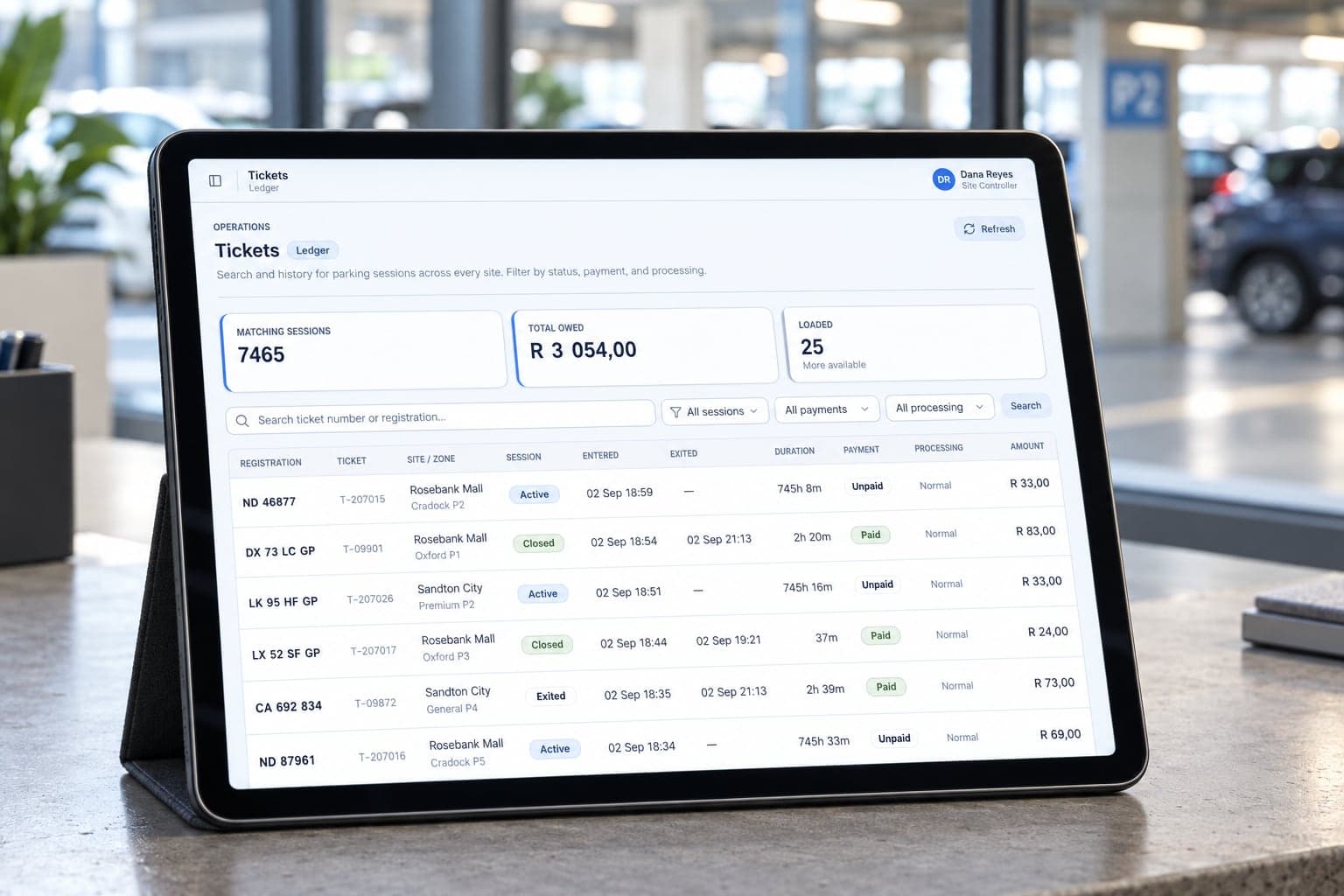
Escalations, verification queues, priority tickets and live entries against exits in one view, so operators see pressure building and act before queues do.
- 04
Access with an expiry date
Visitors, contractors and maintenance vehicles get temporary access that is watched and expires on time, rather than becoming a permanent hole in the fence.
- 05
Money that reconciles
Payments, refunds, accruals and estimates are kept strictly apart in reporting, so the numbers the owner sees are the numbers the bank sees.
- 06
Settings that leave a trail
Grace periods, tariff windows and camera thresholds are versioned per site, so a change is an explicit, auditable act rather than a quiet edit nobody remembers.
How it flows
The Handee Method at the boom
- 01
Discover
We map the lanes, the cameras, the payment flow and the rules of the site: who may enter, what a session costs and what must never happen, like a monitoring fault closing a boom.
- 02
Prototype
In days, a live slice: reads flowing into the cloud, a data model for sessions and payments, and a working control-room screen in front of the people who will run it.
- 03
Build
Production platform, dashboards and integrations, built with the practices money needs: idempotent requests so a retry never charges twice, and append-only logs so every rand and every boom command can be traced.
- 04
Run
After launch we keep watching lane health, anomalies and updates, so faults are flagged as they start and traffic keeps flowing while they're fixed.
See it in practice
See it in practice
Parking & access control
Run the site from one screen
Run the site from one screenTell us about your sites, lanes and equipment, and what the operation can't see today. A few lines is enough to start.
- 01One team for the cameras, the platform and the control room
- 02Payments built so a retry never charges twice
- 03A working prototype before you commit to the full build
What happens next
- 01We read your briefWe come back to you, usually with a few questions about your sites and lanes.
- 02A first callWe talk through the lanes, the cameras, the payment flow and who needs to see what.
- 03A clear proposalScope, timeline and cost for a first phase, so you know exactly what you're committing to.
Questions
Parking and access questions, answered
What operators and site owners usually ask us first.
01Can you work with the cameras and barriers we already have?
That's usually where we start. In discovery we look at what your lanes, cameras and barriers can report and accept, and design the platform around them. If a piece of equipment can't give you what the operation needs, we'll tell you plainly before any build begins.
02What happens when a plate is misread?
Misreads are a fact of ANPR, so the system is designed for them rather than around them. Reads carry a confidence score: sure reads open the boom on their own, uncertain ones go to an operator with the capture in front of them, and accuracy is measured against human labels rather than asserted. In the Crest platform, an advisory second-opinion model also flags suspected misreads for a person to review.
03What happens when something breaks at the lane?
Traffic comes first. We design so nothing in monitoring can ever close a boom: a fault is flagged to the control room while vehicles keep flowing, and lane health watches each lane against its own normal so a quiet camera or a drifted clock is caught within the hour.
04Can it run more than one site?
Yes. The platform is built around a portfolio: each site keeps its own lanes, tariffs and versioned settings, while the control room and reports roll up across all of them, so one shift can watch many sites.
05How do you make sure the revenue numbers are right?
By keeping different kinds of numbers apart. Actual payments, refunds, accruals and estimates of lost revenue are never added together, a late-recorded exit restates its day rather than leaving it wrong, and every financial movement sits in an append-only log that can be traced.
06Number plates are personal information. How is that handled?
Carefully. A plate tied to a time and place is personal information under POPIA, so where the data is hosted, who can see it and how long it's kept are agreed as part of the design, and access is set by role with every sensitive action logged.